



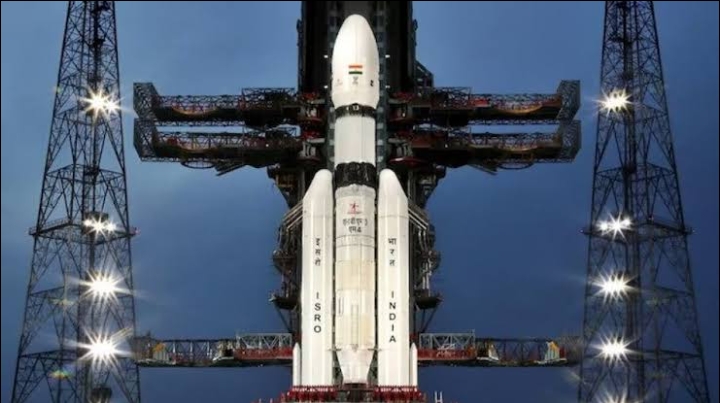

THE OJECTIVES OF CHANDRAYAAN-3
Chandrayaan-3 is the third mission in the Chandrayaan programme, a series of lunar-exploration missions developed by the Indian Space Research Organisation (ISRO). The mission consists of a lunar lander named Vikram and a lunar rover named Pragyan, similar to those launched aboard Chandrayaan-2 in 2019.
Chandrayaan-3 was launched from Satish Dhawan Space Centre on 14 July 2023. The spacecraft entered lunar orbit on 5 August, and the lander touched down near the Lunar south pole on 23 August at 18:03 IST (12:33 UTC), making India the fourth country to successfully land on the Moon, and the first to do so near the lunar south pole. On 3 September the lander hopped and repositioned itself 30–40 cm (12–16 in) from its landing site. After the completion of its mission objectives, it was hoped that the lander and rover would revive for extra tasks, on 22 September 2023, but missed the wake-up call. On September 30, the second lunar night began, eliminating hopes of revival.
History
Further information: Chandrayaan programme
See also: Lunar south pole
On 22 July 2019, ISRO launched Chandrayaan-2 on board a Launch Vehicle Mark-3 (LVM3) launch vehicle consisting of an orbiter, a lander and a rover. The lander was scheduled to touch down on the lunar surface on 6 September 2019 to deploy the Pragyan rover. The lander lost contact with mission control, deviated from its intended trajectory while attempting to land near the lunar south pole, and crashed.
The lunar south pole region holds particular interest for scientific exploration. Studies show large amounts of ice there. Mountainous terrain and unpredictable lighting protect the ice from melting, but they also make landing scientific probes there a challenging undertaking. The ice could contain solid-state compounds that would normally melt under warmer conditions elsewhere on the Moon—compounds which could provide insight into lunar, Earth, and Solar System history. For future crewed missions and outposts, ice could also be a source of drinking water and of hydrogen for fuel and oxygen.
The European Space Tracking network (ESTRACK), operated by the European Space Agency (ESA), and Deep Space Network operated by Jet Propulsion Laboratory (JPL) of NASA are supporting the mission. Under a new cross-support arrangement, ESA tracking support could be provided for upcoming ISRO missions such as those of India's first human spaceflight programme, Gaganyaan, and the Aditya-L1 solar research mission. In return, future ESA missions will receive similar support from ISRO's own tracking stations.
Objectives
ISRO's mission objectives for the Chandrayaan-3 mission are:
- Engineering and implementing a lander to land safely and softly on the surface of the Moon.
- Observing and demonstrating the rover's driving capabilities on the Moon.
- Conducting and observing experiments on the materials available on the lunar surface to better understand the composition of the Moon.[23]
Spacecraft
Design
Chandrayaan-3 comprises three main components: a propulsion module, lander, and rover.
-
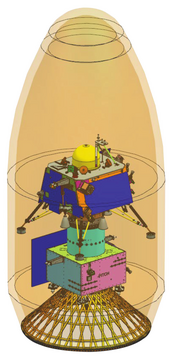
Chandrayaan-3 encapsulated within LVM3's payload fairing
-

Chandrayaan-3 integrated components


Propulsion module
The propulsion module carried the lander and rover configuration to a 100-kilometre (62 mi) lunar orbit. It was a box-like structure with a large solar panel mounted on one side and a cylindrical mounting structure for the lander (the Intermodular Adapter Cone) on top.
A few months after the conclusion of the lander portion of the mission, ISRO officials said that the propulsion module is equipped with two radioisotope heating units (RHU) generating one watt designed and developed by BARC (Bhabha Atomic Research Centre). RHUs keep the spacecraft at their operational temperatures by the decay of radioactive material, leading to electricity generation to power heaters, even with solar power or using battery power. It is to be thought that National Security reasons delayed the disclosure to the media. Chandrayaan 3 project director P Veeramuthuvel said ISRO may soon use nuclear resources to maintain instruments in future rovers. ISRO officials later said the RHUs could not be installed on Chandrayaan 3’s Vikram lander and Pragyan rover because it would have increased their mass which unfortunately led them to have a maximum lifespan of 14 earth days or 1 lunar day.
-

Propulsion module

Vikram Lander
The Vikram lander was responsible for the soft landing on the Moon. It is also box-shaped, with four landing legs and four landing thrusters capable of producing 800 newtons of thrust each. It carried the rover and has various scientific instruments to perform on-site analysis. The lander has four variable-thrust engines with slew rate changing capabilities, unlike Chandrayaan-2's lander, which had five, with the fifth one being centrally mounted and capable only of fixed thrust. One of the main reasons for Chandrayaan-2's landing failure was altitude increase during the camera coasting phase. This was removed by allowing the lander to control attitude and thrust during all phases of descent. Attitude correction rate was increased from Chandrayaan-2's 10°/s to 25°/s with Chandrayaan-3. Additionally, the Chandrayaan-3 lander is equipped with a laser Doppler velocimeter (LDV) to allow measuring altitude in three directions. The impact legs were made stronger compared to Chandrayaan-2 and instrumentation redundancy was improved. It targeted a more precise 16 km2 (6.2 sq mi) landing region based on images provided by the Orbiter High-Resolution Camera (OHRC) onboard Chandrayaan-2's orbiter. ISRO improved the structural rigidity, increased polling in instruments, increased data frequency and transmission, and added additional multiple contingency systems to improve lander survivability in the event of failure during descent and landing.
-

Lander

Rover
The Pragyan rover is a six-wheeled vehicle with a mass of 26 kilograms (57 pounds). It is 917 by 750 by 397 millimetres (36.1 in × 29.5 in × 15.6 in) in size. The rover is expected to take multiple measurements to support research into the composition of the lunar surface, the presence of water ice in the lunar soil, the history of lunar impacts, and the evolution of the Moon's atmosphere.
-

Pragyan rover

Payloads
On lander
- Chandra's Surface Thermophysical Experiment (ChaSTE) will measure the thermal conductivity and temperature of the lunar surface.
- Instrument for Lunar Seismic Activity (ILSA) will measure the seismicity around the landing site.
- Langmuir Probe (LP) will estimate the near-surface plasma density over time.
-
Chandra's Surface Thermophysical Experiment (ChaSTE)
-
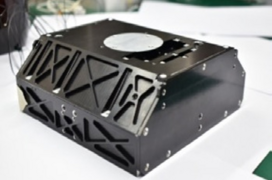
Instrument for Lunar Seismic Activity (ILSA)
-

Langmuir Probe (RAMBHA-LP)


On rover
- An alpha particle X-ray spectrometer (APXS) will derive the chemical composition and infer the mineralogical composition of the lunar surface.
- Laser-induced breakdown spectroscopy (LIBS) will determine the elemental composition (Mg, Al, Si, K, Ca, Ti, Fe) of lunar soil and rocks around the lunar landing site.
-

-
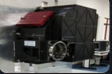
Laser-Induced Breakdown Spectroscope (LIBS)


On the propulsion module
- Spectro-polarimetry of Habitable Planet Earth (SHAPE) will study spectral and polarimetric measurements of Earth from the lunar orbit in the near-infrared (NIR) wavelength range (1–1.7 μm). Findings of SHAPE might aid in future exoplanet research and search for extraterrestrial life.
-

Spectro-polarimetry of Habitable Planet Earth (SHAPE)

Mission profile
Animation of Chandrayaan-3

Around the Earth – Orbit raising phase

Around the Earth

Around the Moon
Chandrayaan-3's Path · Earth · Moon
Launch[edit]
_of_SDSC-SHAR,_Sriharikota_03.webp)
Chandrayaan-3 was launched aboard an LVM3-M4 rocket on 14 July 2023, at 09:05 UTC from Satish Dhawan Space Centre Second Launch Pad in Sriharikota, Andhra Pradesh, India, entering an Earth parking orbit with a perigee of 170 km (106 mi) and an apogee of 36,500 km (22,680 mi). On 15 November 2023, the Cryogenic Upper Stage (C25) of the rocket (NORAD ID: 57321) made an uncontrolled re-entry into the Earth’s atmosphere around 9:12 UTC. The impact point is predicted over the North Pacific Ocean and the final ground track did not pass over India.[38] [39][40]
Orbit[edit]
After a series of Earth bound manoeuvres that placed Chandrayaan-3 in a trans-lunar injection orbit,[41][42][43] ISRO performed a lunar-orbit insertion (LOI) on 5 August, successfully placing the Chandrayaan-3 spacecraft into an orbit around the Moon. The LOI operation was carried out from the ISRO Telemetry, Tracking, and Command Network (ISTRAC) in Bengaluru.[44][45]
On 17 August, the Vikram lander separated from the propulsion module to begin the last phase of the mission.[46]
Landing[edit]

.webp)

On 23 August 2023, as the lander approached the low point of its orbit, its four engines fired as a braking manoeuvre at 30 kilometres (19 mi) above the Moon's surface. After 11.5 minutes, the lander was 7.2 km (4.5 miles) above the surface; it maintained this altitude for about 10 seconds, then stabilized itself using eight smaller thrusters and rotated from a horizontal to a vertical position while continuing its descent.
It then used two of its four engines to slow its descent to roughly 150 metres (490 ft); it hovered there for about 30 seconds and located an optimal landing spot before continuing downward and touching down at 12:33 UTC.
| Stage and sequence | Date/ Time (UTC) | LAM burn time | Orbit | Orbital period | References |
|---|---|---|---|---|---|
| Earth orbit: Launch | 14 July 2023 | — | 170 km × 36,500 km (110 mi × 22,680 mi) | — | |
| Earth bound maneuvers: 1 | 15 July 2023 | — | 173 km × 41,762 km (107 mi × 25,950 mi) | — | [48][49] |
| Earth bound maneuvers: 2 | 17 July 2023 | — | 226 km × 41,603 km (140 mi × 25,851 mi) | — | [48][50] |
| Earth bound maneuvers: 3 | 18 July 2023 | — | 228 km × 51,400 km (142 mi × 31,938 mi) | — | [51] |
| Earth bound maneuvers: 4 | 20 July 2023 | — | 233 km × 71,351 km (145 mi × 44,335 mi) | — | [48][52] |
| Earth bound maneuvers: 5 | 25 July 2023 | — | 236 km × 127,603 km (147 mi × 79,289 mi) | — | [53] |
| Trans-lunar injection | 31 July 2023 | — | 288 km × 369,328 km (179 mi × 229,490 mi) | — | [54] |
| Lunar bound maneuvers:1 (Lunar orbit insertion) | 5 August 2023 | 1,835 s (30.58 min) | 164 km × 18,074 km (102 mi × 11,231 mi) | Approx. 21 h (1,300 min) | [55] |
| Lunar bound maneuvers: 2 | 6 August 2023 | — | 170 km × 4,313 km (106 mi × 2,680 mi) | — | [56] |
| Lunar bound maneuvers:3 | 9 August 2023 | — | 174 km × 1,437 km (108 mi × 893 mi) | — | [57] |
| Lunar bound maneuvers:4 | 14 August 2023 | — | 150 km × 177 km (93 mi × 110 mi) | — | [58] |
| Lunar bound maneuvers:5 | 16 August 2023 | — | 153 km × 163 km (95 mi × 101 mi) | — | [59] |
| Lander deorbit maneuvers: 1 | 18 August 2023 | — | 113 km × 157 km (70 mi × 98 mi) | — | [60] |
| Lander deorbit maneuvers: 2 | 19 August 2023 | 60 s (1.0 min) | 25 km × 134 km (16 mi × 83 mi) | — | [61] |
| Landing | 23 August 2023 | TBC | — | — | [3] |
| Rover deployment | 23 August 2023 | — | — | — | [3] |
-
The Moon photographed by the Lander Position Detection Camera (LPDC) aboard Chandrayaan-3 lander on 15 August 2023
-
View from the Lander Imager Camera-1 (LI-1) on 17 August 2023 just after the separation of the Chandrayaan-3 Lander Module from the Propulsion Module
-

Chandrayaan-3 orbital manoeuvre

Surface operations

On 3 September, the rover was put into sleep mode after it had completed all of its assignments. Its batteries were charged and receiver left on, according to ISRO, in preparation for the impending lunar night. "The rover's payloads are turned off and the data it collected has been transmitted to Earth via the lander", the statement said. Chandrayaan-3's lander and rover were expected to operate only for one lunar daylight period, or 14 Earth days, and the on-board electronics were not designed to withstand the −120 °C (−184 °F) nighttime temperatures on the Moon. On 22 September, the lander and rover missed their wake-up calls,[64][65] and by 28 September neither had responded, diminishing hopes for further surface operations.
Hop experiment
Vikram fired its engines for a brief

Leela Kishore
View Details
 Like
Like 15 Comments
 Repost

You may also like


Dr. Ravi Saripalle
Published 7d+
Why Bad News Hits Harder: The Science of Negativity Bias
Dear Friends,Once, while walking through a narrow street lined with closely packed houses, I came across a typical scene: a heated argument between a husband and wife. Their voices echoed across

Dr. Ravi Saripalle
Published 7d+
Leadership is Light, not Heat!
Leadership is Light, not Heat! Spectacular Picture of the Sky at 2 PM IST 20-12-2022! Let’s build a Healthy Space Competition as No Geography defined!Dear Friends and StudentsToday afternoon,


VENKATESH PANYAM
Published 7d+
How to Learn Physics
Walter Lewin a former professor of physics at the Massachusetts Institute of Technology (MIT) says “ Teachers who make Physics boring are criminals”. I agree with him. Physics

Dr. Ravi Saripalle
Published 7d+
Biodiversity Crisis!
Community Led Grassroots Fightback against Biodiversity Crisis! What is our Vow to Rewild?! Read this PerspectiveDear Friends and StudentsRecently somebody commented on my blog that most of the

Dr. Ravi Saripalle
Published 7d+
Twin Powered Sisters
Twin Powered Sisters Nishita and Nikita Baliarsingh Powering Environmentally through their Startup Nexus Power!! (Non-Science Background but Building Bio Organic and Bio-Degradable)Read this Inspiring


The Art of Teaching
Published 7d+
Lessons in Perspective: A Tale for Teachers
As teachers, we often find ourselves anticipating specific answers from our students. But what happens when their responses diverge from our expectations? This story of a young boy and his math teacher

EdGe: Your Academic Co-pilot
Published 7d+

Ultimate Guide to B.Tech Courses in Andhra Pradesh
⚙ Core Engineering Branches CSE – Computer Science and Engineering Focuses on programming, algorithms, computer systems, and software development. ➤ Opportunities: Software engineer,


A. Rashmi Bhavani
Published 7d+
The Joy of Reading Books. Why Should We Read Books?
The Joy of Reading Books. Why Should We Read Books?When was the last time you read a book? When was the last time you read a quote and reflected on it? When was the last time you sniffed a new book


K. Hanumantha Rao
Published 7d+
Call for Teachers
Those that are associated with teaching know that standard of education is on the decline.Who is responsible for the present state of affairs.Some say that the quality of students is on the decline.

EdGe: Your Academic Co-pilot
Published 7d+
Here’s How You Can Still Build a Rewarding Career in Healthcare
The National Eligibility cum Entrance Test (NEET) is often seen as the ultimate gateway to a medical career in India. For lakhs of students every year, not clearing NEET feels like a roadblock to their

EdGe: Your Academic Co-pilot
Published 7d+
Percentage vs Percentile
✅ Percentage:A percentage is a number out of 100. It tells you how much you scored out of the total marks.✅ Percentile:A percentile tells you how you performed compared to others.

Dr. Ravi Saripalle
Published 7d+
Will AI becomes Obsolete soon?
While the world is grappling with AI, Scientists are Working on OI ! Will AI becomes Obsolete soon?Dear FriendsIn 2018, when we started skill2030.com (AI-Powered Metaverse Based Interview Automation
Related Blogs
Adidam Surya Praneeth
Published 7d+
CHANDRAYAAN-3 and its Objectives
Chandrayaan-3: A new chapter in india’s space odysseyHeartfelt congratulations to the whole community of ISRO for the successful moon landing.This is just the start of our space exploration,and


Sai ganesh
Published 7d+
The future of transportation: How will we get around in 2043
INTRODUCTIONTransportation, defined as “the movement of people or goods from one place to another” by Cambridge dictionary, has evolved with the time, just like every other aspect in life.


ELCSLAB @ Lendi
Published 7d+
3.The joy of reading.Why one should read books.
The joy of reading.Why one should read booksIntroduction:In the age of smartphones, streaming services, and constant digital distractions, the simple act of picking up a book can seem like


K.Nivas
Published 7d+
Why Do We Explore Space?
Why do we explore space? Let's explore what space actually is. According to Google, it says "Space is a three-dimensional continuum containing positions and directions" In simple words "it

EdGe: Your Academic Co-pilot
Published 7d+
B. Tech (4 years) courses offered at IITs
What are the courses offered at IITsThe 23 IITs in India offer variety of courses for the students in different streams. Some of the IITs offer courses like Aerospace Engineering, Agricultural Engineering,


Dr.Tirumala Rao Yalla
Published 7d+
Need for Electrical Vehicles
What is an EV?Electrical vehicle is a vehicle where one or more electrical motors are used for propulsion. These motors will be powered by batteries (for electric cars, two wheelers, etc.) or collector