




Unveiling the Marvels of Nanotechnology: A Journey into the World of the Minuscule
Introduction
Nanotechnology, often referred to as the "science of the small," is a revolutionary field that deals with manipulating matter at the nanoscale, which is roughly one billionth of a meter. In this blog, we will embark on a fascinating journey into the realm of nanotechnology, exploring its origins, applications, and the potential it holds for shaping our future
The Origins of Nanotechnology
The concept of manipulating matter at the nanoscale was first introduced by physicist Richard Feynman in his famous 1959 lecture, "There's Plenty of Room at the Bottom." However, it wasn't until the 1980s that significant advancements in nanotechnology began to take shape. The development of powerful microscopes, such as the scanning tunneling microscope and atomic force microscope,enabled scientists to visualize and manipulate individual atoms and molecules.
Nanotechnology in Practice
Nanotechnology spans a wide range of scientific disciplines, including physics, chemistry, biology, and engineering. Here are some key areas where nanotechnology has made a profound impact:
1.Medicine: Nanotechnology has revolutionized the field of medicine with applications like targeted drug delivery, cancer treatment, and diagnostic tools. Nanoparticles can be designed to carry drugs directly to cancer cells, reducing side effects and increasing treatment effectiveness.
2.Electronics: The semiconductor industry relies heavily on nanotechnology to create smaller and more efficient electronic components. Miniaturization of transistors and the development of nanoscale materials have paved the way for faster and more energy-efficient electronic devices.
3.Materials Science: Nanomaterials, such as carbon nanotubes and graphene, possess remarkable properties that have led to breakthroughs in materials science. These materials are incredibly strong, lightweight, and have excellent electrical and thermal conductivity.
4.Energy: Nanotechnology has the potential to address energy challenges by improving the efficiency of solar cells, developing advanced battery technologies, and creating more efficient energy storage and conversion systems.
5.Environmental Remediation: Nanotechnology plays a vital role in mitigating environmental issues. Nanoparticles can be used to remove pollutants from water and air, making it an essential tool in the fight against pollution and climate change.
Ethical and Societal Considerations
While nanotechnology offers tremendous benefits, it also raises ethical and safety concerns. Some potential risks include unintended consequences of nanoparticles in the environment, privacy issues with advanced surveillance technologies, and the misuse of nanomaterials in weapons or surveillance. It is crucial to strike a balance between harnessing the potential of nanotechnology and addressing these ethical concerns.
The Future of Nanotechnology
The future of nanotechnology is filled with promise. Researchers are exploring innovative applications such as nanorobotics for medical procedures, nanoscale 3D printing, and even the possibility of a "nanofactory" capable of assembling products atom by atom. As nanotechnology continues to advance, it has the potential to reshape industries, improve our quality of life, and address some of humanity's most pressing challenges.
Nano technology has begun to make its mark in the world of fashion, including the design and production of suits. These advancements are not just about making suits look more stylish but also about enhancing their functionality and performance. Here are some ways in which nano technology is being applied to suits:
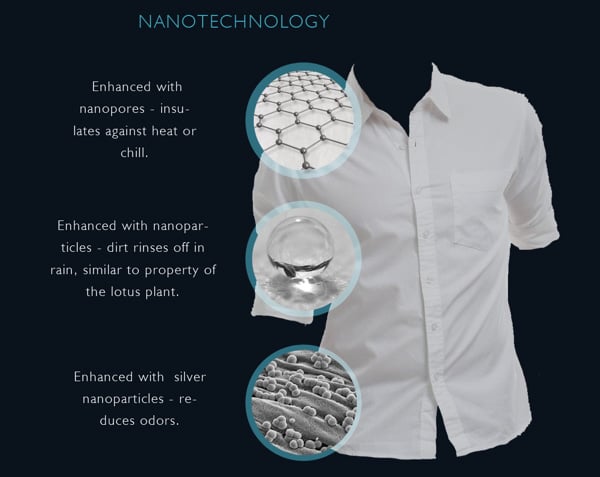
1. Stain and Wrinkle Resistance.
2. Water and Moisture Repellency.
3. Thermoregulation.
4. Antimicrobial Properties.
5. UV Protection.
6. Nanofiber Technology.
7. Customization.
8. Sustainability.
It's important to note that while nano-enhanced suits offer numerous advantages, they may also come with increased production costs. Additionally, the long-term environmental and health effects of certain nanomaterials and treatments need to be thoroughly studied and regulated.
Conclusion
Nanotechnology, with its ability to manipulate matter at the nanoscale, has already transformed various fields and holds great promise for the future. From medicine to electronics, materials science to energy, nanotechnology is at the forefront of innovation. However, it is essential to approach this powerful technology with a sense of responsibility, ensuring that its benefits are harnessed for the betterment of society while addressing ethical and safety concerns. As we continue to unlock the mysteries of the minuscule, the possibilities for nanotechnology seem boundless, offering hope for a brighter and more sustainable future.
THANK YOU
AUTHOR BIO:-
V.D.K.S.R.RAJESH
21KD1A02A6,
ELECTRICAL AND ELECTRONICS DEPARTMENT,
LENDI INSTITUTE OF ENGINEERING AND TECHNOLOGY.

ELCSLAB @ Lendi
View Details
 Like
Like 205 Comments
 Repost

You may also like


Dr. Ravi Saripalle
Published 7d+
Responsible Search
What is India Thinking during Year-End Week (Dec 22 to Dec 28, 2022)? Are You doing a Responsible Search?Dear Friends and StudentsYesterday I got this question while I was walking. What is India


The Art of Teaching
Published 7d+
The Power of Relationships in Education
In the fast-paced world of education, teachers often find themselves juggling lesson plans, assessments, and administrative tasks. However, amidst the hustle, one fundamental truth remains unchanged: education

Dr. Ravi Saripalle
Published 7d+
Biodiversity Crisis!
Community Led Grassroots Fightback against Biodiversity Crisis! What is our Vow to Rewild?! Read this PerspectiveDear Friends and StudentsRecently somebody commented on my blog that most of the

EdGe: Your Academic Co-pilot
Published 7d+

COMEDK UGET
About COMEDK UGET 2025The Consortium of Medical, Engineering and Dental Colleges of Karnataka (COMEDK) conducts the Undergraduate Entrance Test (UGET) for admission to engineering courses in approximately

Dr. Ravi Saripalle
Published 7d+
How Birds Survive -A lesson to learn
A Sudden Gloomy Environment-Recession, Layoffs, and Fear of Technology Replacing Jobs-How Birds Survive and Teach us during Heavy Storms?Dear FriendsOn Sep 23, 2021, I wrote a story on my blog-

Dr. Ravi Saripalle
Published 7d+
A Piece of Advice!
A Piece of Advice Amid Global LayoffsDear 3rd/2nd Year StudentsA Piece of Advice! If it appeals to you, Please consider it. If not, Please ignore this message. There is a famous quote- "Whatever


MOHAMMED NAYEEM
Published 7d+
Why I joined Marine Engineering?
Why I joined Marine Engineering even after clearing my JEE Mains?First let’s understand what Marine Engineering is, and then, why I chose marine engineering.Marine Engineering:It is a field

EdGe: Your Academic Co-pilot
Published 7d+
🎯 Advertising as a Career: A Creative Path to Influence and Impact
🎯 Advertising as a Career: A Creative Path to Influence and Impact🧠 What is Advertising?Advertising is the art and science of communication aimed at promoting a product, service,


VENKATESH PANYAM
Published 7d+
Beyond the Blackboard: Inspiring Movies Every Teacher Should See
Lights, Camera, Action! Must-Watch Movies for Every TeacherAs teachers, we dedicate ourselves to shaping young minds and fostering a love of learning. But sometimes, even the most passionate educators


Sandip University
Published 7d+
Which MBA is best for placement?
There is no single "best" MBA program for placement, as different programs can offer strong placement outcomes for different industries and career paths. However, each stream of MBA studies can

The Art of Teaching
Published 7d+
Guiding Teenagers: Empowering Growth, Not Solving Problems
Teenagers often seem like puzzles—their behaviors, emotions, and choices can be perplexing to those who care for them. As parents, educators, or mentors, we may feel compelled to “fix”

EdGe: Your Academic Co-pilot
Published 7d+
Engineering Entrance Exams
Every year students who want to pursue their career in engineering apply for different engineering entrance exams. To help such students we are giving all the popular engineering entrances at one
Related Blogs

ELCSLAB @ Lendi
Published 7d+
NEW NANO TECHNOLOGY
Nanotechnology is the manipulation of matter on a near-atomic scale to produce new structures, materials and devices. The technology promises scientific advancement in many sectors such as medicine,

ELCSLAB @ Lendi
Published 7d+
UNVEILING THE SINISTER; A DARK JOURNEY INTO THE TWISTED WORLD OF SE7EN
INTRODUCTION : The basic of plot of the film- "Se7en is a thrilling crime movie where two detectives hunt down a serial killer who uses the seven deadly sins as inspiration for his murders.

ELCSLAB @ Lendi
Published 7d+
The Future of Artifical Intelligence in Engineering: Building Tomorrow's World
The Future of AI in Engineering: Building Tomorrow's WorldIntroduction:As

ELCSLAB @ Lendi
Published 7d+
The Future of Artificial Intelligence in Engineering
Title: The Future of Artificial Intelligence in Engineering Introduction Artificial Intelligence (AI) is rapidly changing the landscape of various industries, and engineering is

ELCSLAB @ Lendi
Published 7d+
ARTIFICIAL INTELLIGENCE THE FUTURE OF WORLD
IntroductionArtificial Intelligence has emerged as a transformative force, revolutionizing industries, enhancing productivity, and reshaping the way we live and work. As we look to the


S210837 SINGARAPU PRAVALIKA
Published 7d+
A Journey To Inspire, Innovate And Discover..!
SO MUCH UNIVERSE AND SO LITTLE TIME..! -- Embracing The Infinite Cosmos With Limited TimeIntroduction:In an era where our planet is more interconnected than ever, the call to explore space resonates