



About me
I am a Physics Teacher. I love making complex topics engaging and understandable. My teaching style incorporates humor, relatable examples, connect with students at all levels..
Hey ,
I am participating in
Edgroom's Educators Excellence Awards - 2024Here are the reasons why you should vote for me!
Teaching methods include differentiated instruction, lecture-based instruction, technology-based learning, group learning, individual learning, inquiry-based learning, kinesthetic learning, game-based learning and expeditionary learning
Traditional resources: Textbooks, reference books, lesson plans, workbooks, flashcards, charts and supplemental reading materials. Graphic and interactive materials: Physical objects, photographs, illustrations, charts, graphs, maps, multimedia, movies and games,textbooks, paper, homework assignments, visual aids, selections for student reading, and workbooks for assignments in school classes.
It's never ever replace Teacher....But AI in teaching and learning will become the norm in the coming years. AI in education, students, due to their wide exposure, can use it for their learning purposes. Therefore, teachers must exercise caution when implementing AI in the learning process to prevent its improper use. In my opinion, change needs to be accepted in the field of education. Definitely, it can be a lifesaver for students and teachers in many ways. AI can reduce teachers' workloads and be used for regular activities. Teachers can focus on polishing their teaching styles and making their teaching more effective. Students can use AI for their growth. In the coming future, AI can act as their tutor and teach them anywhere, anytime, with plenty of resources that AI has access to. But one thing to focus on here is the relationship that teachers and students hold in the classroom with AI. Previously, the only source of knowledge was the teacher in the classroom, but that is going to change totally. Teachers need to focus on developing the life skills of the students and helping them grow socially, as they are going to be associated with systems and screens rather than socializing. Speaking of quality, the quality would increase enormously beyond our imagination. The rate at which students learn the concepts would be mind-blowing, as there is no need to wait for anyone to teach the subject. They can learn on their own; the teacher may become like a facilitator to the students and give them insights into where they can learn and where they need to focus. To our surprise, the AI would also give those reports detailed and customized to each student; all the teacher needs to do is help them focus on those specified points and help students enhance their results. The teacher's role is to drive students toward the application of the concepts in real life.
By personalizing learning, using gamification, providing real-world applications, giving positive feedback, utilizing technology, encouraging peer collaboration, setting clear goals, providing student autonomy, fostering positive relationships, and recognizing student achievements, educators can create a classroom that .One way to encourage students and teach them responsibility is to get them involved in the classroom. Make participating fun by giving each student a job to do. Give students the responsibility of tidying up or decorating the classroom. Assign a student to erase the blackboard or pass out materials.
The common myth about learning styles affecting learning has done one good thing: every student benefits from various approaches to the same phenomenon. If they smell, hear, see and touch and do something with their bodies and hands, it makes it both easier to concentrate on the lesson (unless it is too much for some students) and it helps to construct permanent memories. Students do not learn better if the teacher tries to “support their learning styles” because the myth that they can only learn in one way is simply not true (according to several studies) and it can be hard to unlearn. Basicly, it is the meaning that should be processed in the class and not just information via one canal. However, at the heart of learning is the content. It depends on it, how it is best taught. The individually tailored or chosen exercises can make it easier for every student to get to a better cognitive depth of the subject matter. Some students enjoy working together for creative activities or problem solving tasks. Some do their best when they study alone. A teacher can help introverts in the classroom by offering several ways to deliver. A quiet student can show their learning by writing an essay when an extrovert wants to speak up or make a video. I try to balance the amount of work which is done in the comfort zone to that taken on the demanding territory so that it is sometimes relaxing to study but occationally everybody has to do steps to grow or strengthen their developing abilities. Most students think they know how they learn but don’t. The feeling of being efficient or studying hard does not always correlate with results. It is the teacher’s job to know better. Still, there are sometimes students who know their learning style and what is required for deep learning. I listen to them and most of the time we find a way which is good for them. An example: some students like to have quizzes, others rather do exercises. The competition of a quiz empowers some and makes others anxious. The solution: the quiz is played by those who think they can benefit from it and the student who wants to learn the new terms in another way is allowed to do so.
Education system in a country is to be designed to shape up the future generations. It should prepare the younger generation to think for a better tomorrow. It should instil confidence in their minds. It should teach them to respect fellow human beings. Indian education system is well known for the rote learning. If I ask a student from India, What is the purpose of your education? He or She will say, I want to serve the society or I want to earn money and lead a comfortable life. How can one serve a society without knowing how to do that service? Indian education system doesn't enlighten student's minds. Let me take CBSE board. CBSE syllabus is framed by a group of experts formed by NCERT board. If you look into the CBSE books, you can see an elaborate syllabus coverd in detail. It may offer knowledge to a student but not a stimulus. We are living in an era of information. Information and knowledge hence are available in everybody's finger tips in the form mobile, tab, computer etc., And these NCERT books are not even edited once in ten years. Student is expected to grasp from the only version given in the book. If the teacher is good, he/she will bring better clarity in a subject to majority of students in his/her class. Only few schools have many such good teachers, may be 1%of schools in India. Such schools may not be reachable to the bottom of the society. It infers that correction has to be given in syllabus, teachers and schools, then comes infrastructure and guidance. Correcting all the above factors may take another half a century for a country like India. NEP also tries to do the same. Above can be done in phases. Student's mindset should be changed in the first instance. For that one needs to design a curriculum which can teach a student by itself. This is a curriculum/syllabus change which encourages the student to think more and to innovate more. For eg., if there is a chapter on elecromagnetism for 12th physics syllabus, that chapter should be written in an illustrated simple manner by an electromagnetic scientist. Reference for that chapter will have small small 10 minutes videos as YouTube links by different experts in the same field, so that student can himself work on the topic with the help of visual and text media. This will reach even a student from a remote village, despite the lack of good teachers and good schools in that village. Similarly a separate set of curriculum can be designed for teachers which can guide them to teach the particular topic to the students. So a well designed curriculum forms the fulcrum of education system. This can bring in changes, the way students think, the way teachers think and also the way schools think. A well groomed curriculum can slowly change the entire system. Students will start to think for themselves and become innovative. Now, the majority of doctors, engineers, lawyers and other professionals come from a group of students who are fortunate enough to study in better schools in larger towns and cities. This change will educate the entire population evenly, which results in larger group of innovative youngsters. The rote system can be eliminated altogether. Students who have more innovative ideas can be placed in correspondingly higher skilled professions. They can be given extra credits for new projects, research or innovations during the school education. A fair group of expert panels can be set up all over India to score these inventions and they can be patented under the same student. These innovations and research initiatives will change the dimension of our education system and will take our country to great heights. It's difficult to change everything at a time to improve education system in India since it's going in the wrong path over the years. So focus only on curriculum which is the fulcrum of good education.
Subjects Taught
10th - Physics (Teaching currently)
State Board (A.P)Work Experience
Dr B R Ambedkar Gurukulam - West Godavari
PGT Physical scienceJul 2009 - Present
Education
Andra university - West Godavari
State Board (A.P)Post Graduation(PG) - GeneralA S N M degree college - West Godavari ,palakollu
State Board (A.P)Under graduation(UG) - BScAwards and Certificates
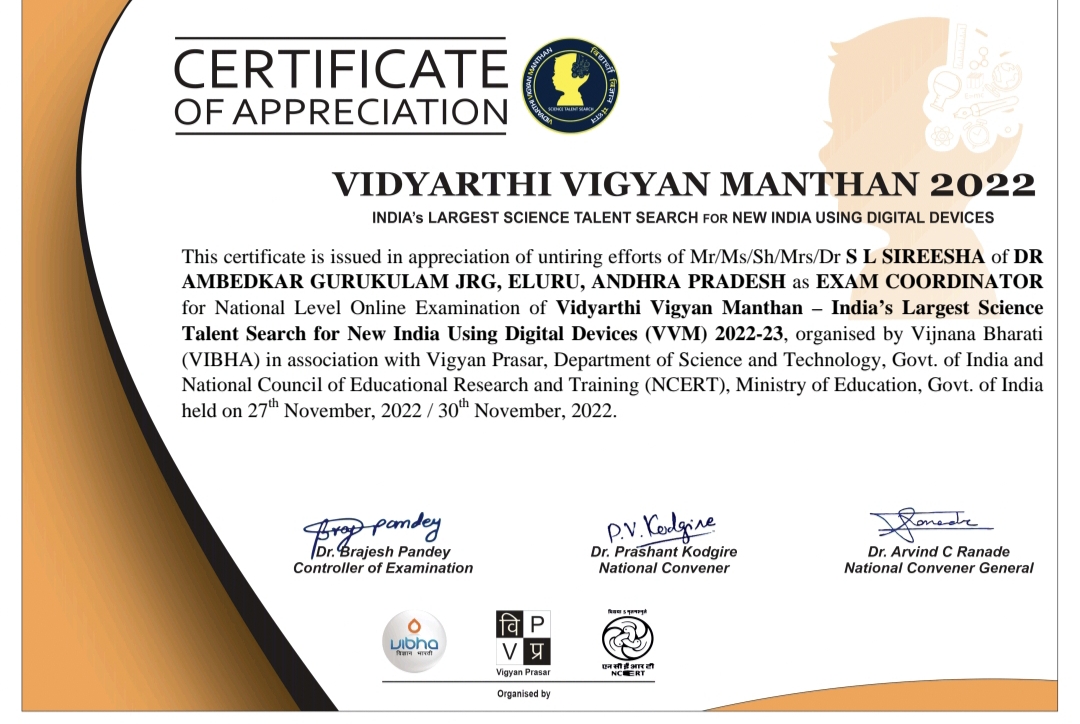
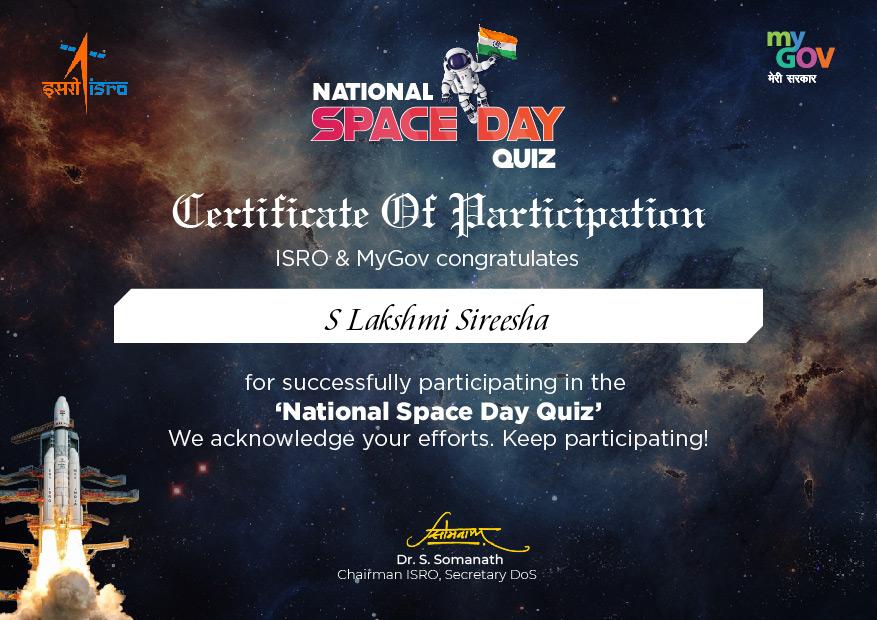
National space 🚀 day
Issued by ISRO Aug 2024National The soft-landing was followed by successful deployment of Pragyan Rover. The landing site was named as 'Shiv Shakti' point (Statio Shiv Shakti) and August 23 was declared as the "National Space Day". India will celebrate its maiden National Space Day on August 23, 2024