




Quantum Computers
Abstract—This research suggests that quantum computing brings together ideas from classical information theory, computer science, and quantum physics. This modern way of computing is based on the science of quantum mechanics and its unbelievable phenomena. It Theoretically has computing power that is many orders of magnitude greater than that of conventional computers.
Keywords—entanglement, a quantum bit (qubit), quantum logic gates, decoherence, superposition
I.Introduction
Quantum computing is one of the hottest topics in the technology sector today. The technology enables individuals and companies to solve computational problems previously considered intractable. Cryptography, chemistry, quantum simulation, optimization, machine learning, and numerous other fields have been significantly impacted by this technology. While quantum computers aren’t going to replace classical immediately, quantum technology is significantly changing the way the world operates. Quantum computing is generally viewed as a field of study centered on developing computer technology based on the principles of quantum theory. This area of physics explains how matter and energy behave at the atomic and subatomic levels.
1.1 Existing system
Classical computing is another name for binary computing. In this traditional approach to computing, information is stored in bits that are represented logically by either a 0 (off) or a 1 (on). Today's processors, including x86 and ARM Processor, support classical computing.
1.2Motivation
Quantum computers can solve what computer science calls "NP-complete" problems, the problems that are impossible or nearly impossible to calculate on a classical computer.
The trick in quantum computing is to harness the entanglement of different particles -- what Einstein called the "spooky action at a distance" -- that allows one particle to affect another somewhere else.
II.System Overview
The Quantum Computer is programmed by changing the magnetic conditions around quantum bits, or "qubits," creating relationships between them that model the physical embodiment of the equation the programmer is trying to solve. The results are read by detecting the direction of the current within the qubit when the calculations are complete.
Qubits are prone to errors. All sorts of environmental factors like thermal fluctuations, electromagnetic radiation, and magnetic fields can knock a qubit out of its intended state. That degradation of information is known as decoherence and can occur in a fraction of a second. Despite the use of refrigeration to reduce thermal fluctuations, decoherence eventually creeps in and produces hardware errors, like accidentally flipping a qubit’s state from 0 to 1.
1.1 Logic-level compilation
A quantum circuit is a map of sequential logic gates that are applied to a series of qubits to run an algorithm. A simple example of a circuit that two qubits in a Bell state are shown
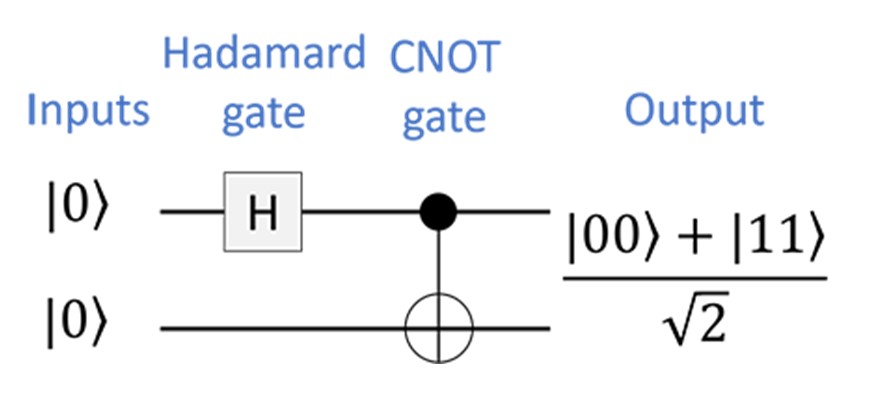
Two qubits start in pure 0 states. A Hadamard gate acts on the first qubit and puts it in a superposition of states 0 and 1 with an equal probability of finding the qubit in each state. The two-qubit CNOT gate flips the target qubit (⊕) to 1 only if the control qubit (•) is in state 1, thereby producing the entangled output state shown.
1.2 Quantum algorithms and applications
Quantum algorithms play the same role as classical algorithms: They provide step-by-step instructions for completing a computational task.
Although a regular algorithm could in principle be run on a quantum computer, a true quantum algorithm takes advantage of the underlying hardware’s quantum nature. For example, manipulating one qubit in a quantum computer affects the entire n-qubit state and each of the 2n coefficients needed to describe it, effectively doing that many operations in parallel. However, it’s not quite parallel computing. When the final qubit states are measured, each is either a 0 or a 1; the algorithm outputs only n values rather than all 2n coefficients.
Quantum Fourier transforms are also significantly faster than their classical counterparts. Other tasks, such as playing chess, garner little to no benefit from quantum algorithms because the number of steps needed would still grow too quickly with the complexity of the problem.
A variational quantum algorithm is a compromise between classical and quantum ones. It breaks up a computation into a small quantum component and a larger classical optimization problem and therefore requires a much smaller quantum computer than, say, the quantum Fourier transform. Such algorithms are promising for solving problems in finance, logistics, and chemistry.
III. User Interface, QAAS, and Operating System
Most people who want to use quantum computers aren’t going to build or even buy one—at least not anytime soon. To facilitate access to the limited existing quantum computing resources, companies have put together cloud-based infrastructures that allow remote operation. As in a classical computer, the highest level of the quantum computing stack provides the interface that users interact with.
Amazon Braket, Microsoft Azure Quantum, and Rigetti Quantum Cloud Services are examples of quantum-as-a-service (QAAS) offerings. However, those companies aren’t necessarily providing access to their own quantum computers; rather, they connect users and computers. For example, Amazon Braket can connect users to resources from D-Wave, Rigetti, and IonQ. That approach makes quantum computers similar to other managed, cloud-based computational resources, such as graphical processing units.
The above services can be used to write code using high-level programming languages. The resulting algorithms probably wouldn’t look particularly exotic to someone with programming experience. For example, the open-source software development kits Ocean (from D-Wave), Qiskit (from IBM), and Forest (from Rigetti) support the programming language Python. Languages specifically designed for quantum computing include Quantum Computation Language (QCL), which resembles C, and Q Language, which works as an extension of C++. The code defines a sequence of operations that constitute a logical algorithm.
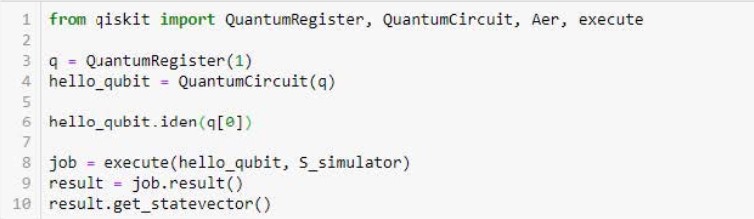
A short Qiskit algorithm, akin to a “Hello, World!” program, initializes one qubit in state 1.
IV. Acknowledgement
We sincerely thank the faculty of the Electronics and Communication Engineering Dept. at Anil Neerukonda Institute of Technology and Sciences for giving me the chance to write this paper. Without their active involvement and the right guidance, this would not have been possible.
V. References
- https://science.jrank.org/computer-science/Quantum_Computers.html
- https://www.sri.com/story/a-brief-introduction-to-quantum-computing/#:~:text=Quantum%20computing%20is%20generally%20viewed,the%20atomic%20and%20subatomic%20level
- https://blog.wordvice.com/formatting-research-paper-headings-and-subheadings/
- https://www.techtarget.com/whatis/definition/classical-computing#:~:text=Classical%20computing%20is%20another%20name,ARM%20processors%2C%20support%20classical%20computing
- https://www.wired.com/2007/02/the-father-of-quantum-computing/#:~:text=Deutsch%20invented%20the%20idea%20of,possible%20forms%2C%20across%20multiple%20universes.
- https://physicstoday.scitation.org/do/10.1063/pt.6.1.20210305a/full/#fifth_sec
Shankar Nambala
Dept. of Electronics and Communication Engineering
Anil Neerukonda Institute of Technology & Sciences
Visakhapatnam, India
nssaiumashankar.20.ece@anits.edu.in
Note: Opinions expressed by authors are their own.

Padala Satyanarayana (SN Sir)
View Details
 Like
Like 0 Comments
 Repost

You may also like

EdGe: Your Academic Co-pilot
Published 7d+

Dual Degree ( B. Tech + M. Tech) 5years courses
Generally many students who are unable to enter into IITs for under graduation, prepare for GATE (Graduate Aptitude Test in Engineering) exam to do Masters Degree in Technology after their B. Tech course.


Bade Ramyasri
Published 7d+
The Timeless Legacy of Indian Mathematics
"Indian mathematics has always been a bridge between abstract thought and practical application, laying the foundation for the mathematical discoveries that shape our modern world."Indian

Anuradha Tenneti
Published 7d+
How to Master Organic Chemistry
Organic Chemistry is one of the most scoring sections of JEE if prepared smartly. Begin by building strong fundamentals from NCERT and a standard book like Morrison & Boyd or Solomons


Dr. Ravi Saripalle
Published 7d+
Why Universities Should Prioritize Teacher-Mentors
Why Universities Should Prioritize Teacher-Mentors Over Traditional Teachers in Today's World?Dear Friends and Students,Recently, I received a question from an educator: Should institutions

Dr. Ravi Saripalle
Published 7d+
Did you decide to Quit your Job?
Decide to Quit your Job? Before Writing Resignation, Read this Job Description!Dear Friends and StudentsAmid the Global Recession, one of my known contacts decided to quit the job! Did I ask why?


VENKATESH PANYAM
Published 7d+
Sunflowers Trait
Dear students when you score low marks or when you fail to get what you want, you may feel bad and want to give up. Wait a minute, don’t lose hope. Talk to your parents, or friends or teachers, and

EdGe: Your Academic Co-pilot
Published 7d+
Here’s How You Can Still Build a Rewarding Career in Healthcare
The National Eligibility cum Entrance Test (NEET) is often seen as the ultimate gateway to a medical career in India. For lakhs of students every year, not clearing NEET feels like a roadblock to their

EdGe: Your Academic Co-pilot
Published 7d+
Top 10 Soft Skills Essential for Career Success: A Guide for Students
In today's dynamic job landscape, technical skills alone are not enough. Employers seek professionals who are adaptable, collaborative, and emotionally intelligent. Here's a look at the top 10


Uma Maheswari
Published 7d+
How we won Smart India Hackthon?
SMART INDIA HACKATHONSmart India Hackathon is a National wide platform initiated to enhance and utilize the innovation and creativity of students which helps the nation.In this many organizations

VENKATESH PANYAM
Published 7d+
Nurturing Success Through Genuine Connections in Education
In the vast landscape of education, the foundation for true success is not solely built on textbooks and exams. Instead, it flourishes within the realm of human connection. My blog delves into the paramount


K. Hanumantha Rao
Published 7d+
Importance of Comment
All of read articles or material as part of our curriculum.We agree with some ideas and may not agree with some ideas expressed by the author or writer.With the advent of social media, we are exposed to

EdGe: Your Academic Co-pilot
Published 7d+
A Mathematician Who Inspires and Transforms
Dr. Umadhar Patnaik is the Managing Director of Ascent Classes and HOD of Mathematics in Visakhapatnam.Dr. M. Umadhar Patnaik, an exceptional mathematician and dedicated educator, has been a beacon
Related Blogs

EdGe: Your Academic Co-pilot
Published 7d+
Computer Science Engineering
What is computer science Engineering Computer Science Engineering (CSE) is an academic programme that integrates the field of Computer Engineering and Computer Science. It is one

Dr. Ravi Saripalle
Published 7d+
Is Computer Science Course an Opportunity or Obsession?
Is Computer Science Course (2022 Beyond) an Opportunity or Obsession? Fad or Fortune? Vertical Skill or Horizontal Skill? Read this perspectiveDear Friends and StudentsThe California Gold Rush


ELCSLAB @ Lendi
Published 7d+
Jobs that AI cannot replace
Title:- Jobs that AI cannot replace Introduction:-Artificial intelligence is a speciality in computer science that is concerned with creating systems that can replicate

MULA LAKSHMI PRASANNA
Published 7d+

FUTURE OF AI IN ENGINEERING
FUTURE OF AI IN ENGINEERING BRIEFING ON AI So by now, every student in this globe from the age above 17 is very familiar with the word AI(Artificial intelligence). There is no introduction

ELCSLAB @ Lendi
Published 7d+
THE ROLE OF TECHNOLOGY IN SHAPING OUR FUTURE
INTRODUCTION:Technology is like a superhero that's changing our world. It helps us do amazing things, like talking to friends far away or even making robots. It improves the growth of the nation.


HarshikaYadav
Published 7d+
Why do you want to become an engineer?
**-Engineering is the designing, testing and building of machines, structures and processes using maths and science. Studying it can lead to a rewarding career**.-Engineering is a discipline dedicated